What Does Market Research Cost in the USA? Budget Ranges & Key Factors
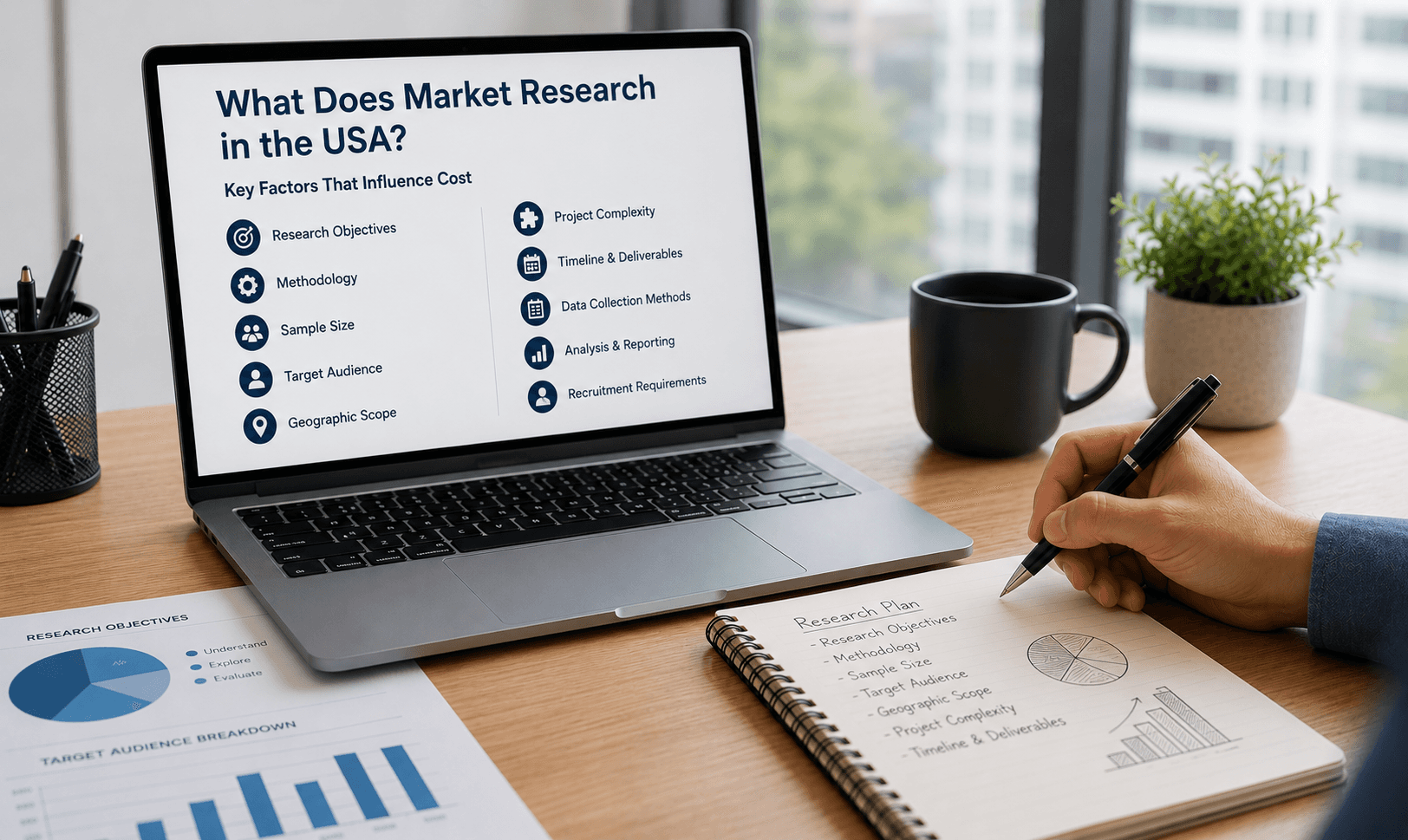
Market research is one of those investments businesses often make before committing to something bigger. Whether you are launching a new product, entering the US market, testing customer demand, adjusting pricing, or improving brand positioning, research helps reduce guesswork before major decisions are made.
But how much does it actually cost?
The market research cost in the USA can vary widely based on your audience, sample size, methodology, timeline, incentives, and final deliverables. A simple online survey and a full-service strategic study may both fall under “market research,” but they require very different levels of planning, recruitment, analysis, and investment.
This guide gives you a clear, practical look at the cost of market research services in US, with real examples to help you understand what to budget before starting your next research project.
How Much Should You Budget for Market Research in the USA?
The cost of research is easier to understand when you look at what it protects: product decisions, pricing calls, customer strategy, and market expansion plans. ESOMAR’s Global Market Research 2025 data, reported by Research World, notes that the global insights industry surpassed US$150 billion in 2024 and is expected to cross US$160 billion by the end of 2025.
That scale reflects how often companies now rely on research, analytics, and reporting before making decisions around products, pricing, customers, and expansion. In practical terms, market research in the USA can start from $5,000 for a focused survey and go beyond $100,000 for a complex custom study.
For many small to mid-sized projects, businesses usually budget between $15,000 and $50,000, depending on the objective, audience, methodology, timeline, and reporting needs. These US market research budget examples and pricing ranges can help businesses get a practical starting point before requesting a custom quote.
Research project | Typical budget range | Real-world example |
Basic surveys | $5,000–$20,000 | 300–500 US consumers answering product, pricing, or feedback questions |
Focus groups | $10,000–$50,000 | Moderated groups are used for product reactions, claims testing, or brand perception |
Comprehensive market studies |
$20,000–$100,000+ | Market sizing, competitor analysis, customer research, and strategic recommendations |
Ongoing tracking programs |
Varies by frequency and depth | Monthly or quarterly tracking for brand health, customer experience, or category shifts |
These figures are directional estimates, not fixed package rates. Final pricing can shift with respondent availability, screening complexity, incentives, geography, timeline, and reporting depth. Two projects may both be called “market research,” but their costs can look very different. A short survey with general consumers will cost much less than a study involving healthcare professionals, business owners, or C-level executives.
Similarly, DIY or secondary research may cost less upfront, but it usually cannot offer the same custom data, respondent targeting, quality checks, or strategic analysis as a professionally managed study.
That is why most research firms share customized quotes after understanding the business objective, audience, methodology, timeline, and deliverables.
Choosing the Right Research Method for Your Budget
The right research method is not always the cheapest one; it is the one that gives you enough confidence to make the next business decision. A survey may be ideal when you need measurable answers from a larger audience, such as demand, pricing preference, or purchase intent.
This is often where qualitative vs quantitative research cost USA becomes important, because each method answers a different kind of business question. Focus groups and in-depth interviews are better when the “why” matters, why customers hesitate, why they trust one claim over another, or why they choose a competitor.
For example, a beverage brand planning to launch a low-sugar energy drink in the USA may start with a 500-response survey to measure flavor preference, packaging appeal, price sensitivity, and likelihood to buy.
That can show which concept performs best. But if the decision depends heavily on sensory response, our study on product taste testing research shows how product experience, flavor preference, and consumer response can add another layer to launch decisions.
If your team wants to go beyond what customers choose and understand why they choose it, tools such as qualitative research and AI in market research can help uncover deeper motivations.
For bigger decisions, such as entering a new market, repositioning a brand, or selling to niche B2B buyers, a mixed-method approach often gives better value. This is especially relevant when comparing B2B market research pricing USA, where recruitment, respondent seniority, and depth of analysis can change the scope. The goal is not to spend more; it is to avoid spending on the wrong answer. Market Xcel helps businesses align the research method with the risk, audience, timeline, and budget behind the decision.
What Can Increase or Lower Your Market Research Quote?
A market research quote does not change only because one firm charges more than another. It changes because the work behind the study changes. The audience, screening criteria, geography, timeline, incentives, and level of analysis all shape the final quote.
For example, a short survey with everyday grocery shoppers is usually easier to manage than a study with verified small business owners. The second project needs tighter screening, better-quality sample, and often higher incentives because the audience is more specific. This is often where B2B research cost starts to differ from broader consumer research.
The same applies to qualitative research. Speaking with regular skincare users about packaging preferences is very different from conducting in-depth interviews with CFOs, physicians, procurement heads, or hospital administrators. Senior or niche respondents take longer to recruit, and their time costs more, which is why qualitative research cost can shift based on respondent profile, interview depth, and analysis needs.
What Do Market Research Services Include in the Final Quote?
Once you know which research method fits your goal and what can increase or lower the quote, the next question is simple: what are you actually paying for?
A market research quote is rarely just a fee for collecting responses. It reflects the work needed to properly design the study, reach the right audience, collect high-quality data, and turn that data into decisions your team can use. A clear research cost breakdown helps businesses see where the budget goes, from recruitment and fieldwork to analysis and reporting.
For online surveys, this may include questionnaire design, survey programming, audience targeting, sample recruitment, fieldwork monitoring, data cleaning, and analysis. For example, if a food brand wants to test a new breakfast product, the research team will not only ask whether people would buy it. They may test taste expectations, price comfort, pack size, purchase frequency, competitor comparison, and reasons for rejection. The cost of surveys can shift depending on sample size, targeting filters, and how much analysis is needed after fieldwork.
For customer-led projects, the value of research often comes from turning feedback into action. You can also read our guide on how to turn customer feedback into sales.
For qualitative research, the quote may include screener development, participant recruitment, moderator preparation, discussion guide creation, interviews or focus groups, incentives, recordings, transcripts, and theme analysis. If a healthcare company wants to speak with verified physicians, the cost also reflects the effort needed to recruit the right professionals and make each conversation useful.
The final deliverables also shape the quote. Some projects may end with topline findings, while others require a detailed report, dashboard, segmentation, strategic recommendations, or an executive presentation. This is where consumer research pricing often depends not only on fieldwork, but on how deeply the findings need to be interpreted for business use.
How to Plan a Market Research Budget Without Overspending
By this point, you know that market research cost depends on the method, audience, scope, and deliverables. The next step is making sure your market research budget is tied to the decision you actually need to make.
Overspending often happens when businesses try to research everything at once. For example, a subscription meal kit startup may want to study every major US region, test multiple customer groups, compare competitors, and evaluate pricing in one go.
But if the immediate decision is whether urban working professionals would pay for a weekly healthy meal plan, the study can be tighter: focus on that audience, test the strongest concepts, and ask only the questions that affect launch readiness.
That does not mean cutting corners. It means removing the parts that do not change the decision. A brand preparing for a nationwide retail launch may genuinely need regional comparisons, competitor analysis, and deeper reporting. A startup validating early demand may not.
If your project involves retail, FMCG, or consumer-facing categories, reviewing current US consumer trends can help sharpen the research scope before fieldwork begins.
To control costs, businesses can narrow the audience, prioritize essential questions, reduce unnecessary geographies, or phase the research. The aim is to keep the research project cost aligned with the decision, so you are not paying for extras that only make the report longer. In that sense, good research pricingis not about spending less; it is about spending where the insight will actually change the next move.
When Should You Hire a Market Research Firm?
A market research firm becomes valuable when the decision needs more than internal judgment or surface-level feedback. Maybe you are preparing to launch in the US, change your pricing, pitch investors, or reposition a brand that has stopped growing. In cases like our B2B food service market entry research study, the value lies in speaking to the right operators, buyers, or decision-makers before committing to the market.
At that stage, you do not just need opinions. You need answers that can hold up when the leadership team asks, “Are we sure?”
It becomes even more important when the audience is hard to reach. A SaaS company selling to hospitals, for example, cannot build its strategy around casual feedback from general business users. It needs to hear from the people who actually influence the purchase: IT leaders, procurement teams, operations heads, or clinical decision-makers. Here, B2B research cost is less about the number of conversations and more about the quality of access.
DIY research may work when you are exploring early ideas or reviewing publicly available information. Bank of America notes that informal primary research can often be done for free by talking to customers, while the trade-off is reliability when the decision carries higher risk.
That is when professional research starts to pay for itself. Good research agency pricing should make the research project cost feel connected to the decision, not like a generic service fee.
Conclusion
Market research pricing becomes easier to understand when you look at the business purpose behind it. A quick survey may be enough to test early interest, while a deeper study may be needed when the decision involves a US launch, pricing change, brand repositioning, or expansion plan.
Before comparing quotes, businesses should look at the scope behind them: the audience being reached, the difficulty of recruitment, the method being used, and the level of analysis expected. These are the details that shape market research cost in the USA and determine whether the investment will give your team enough confidence to move forward.
If you are planning a study, contact us today to discuss your research needs and get a customized quote from Market Xcel. Our team can help you define the right scope, select the appropriate methodology, and develop a research plan aligned with your business goals and budget.