Retail Audit Study for Brand Market Share and Store Performance Tracking
Retail Audit
Client
A leading market intelligence and analytics company wanted to evaluate brand market share, retail performance, compliance, product profiling, and in-store product movement across retail outlets in India. The study was designed as a recurring monthly retail audit to help brands measure retail success, understand shopper experience with products in-store, track sales movement, and monitor product shelf life across categories such as telecom, consumer durables, small domestic appliances, IT, tyres, inverters, and batteries. This retail audit study supported ongoing retail measurement research across categories.
Objective of the Study
The primary objective of the study was to evaluate brand market share and retail performance across selected retail stores.
Key objectives included:
Measuring brand-wise market share across retail outlets through brand wise market share analysis in retail
Evaluating retail store performance and compliance through retail store performance tracking research
Capturing product profiling at outlet level
Understanding shopper experience with products in-store through shopper insights research
Tracking product shelf life and monthly sales movement through product movement tracking
Capturing product category, brand, model sold, units sold, and price per unit
Supporting brands with ongoing retail success measurement
Research Methodology
Market Xcel conducted a recurring retail audit across a large panel of stores. Each outlet was classified by channel and shop size to support structured analysis and accurate market measurement.
Research Approach:
Monthly retail audit and outlet-level sales tracking
Methodology:
Retail store visits, sales data collection, outlet classification, software-based data entry, centralized cleaning, and quality checks
Sample Size:
11,000 stores per month
Fieldwork Duration:
Tyre audits: 16th to 30th of every month
Non-tyre audits: 1st to 8th of every month
Data Collection Cycle:
Tyre audits: Data collected from 16th to 29th of the month for sales recorded from the 16th of the previous month to the 15th of the current month
Non-tyre audits: Data collected from 1st to 8th of every month for the last 30 days of sales
Channel Classification:
Telecom: Mobile handset selling outlets
Major Domestic Appliances: Refrigerator, washing machine, air conditioner, and television outlets
Small Domestic Appliances: Kitchen appliances and electrical material outlets
Inverter / Battery: Home inverter, battery, and automotive battery outlets
IT: Desktop, laptop, printer, mouse, keyboard, and IT-related product outlets
Tyre: Two-wheeler and four-wheeler tyre outlets
Shop Size Classification:
Small
Medium
Large
Extra Large
Key Information Captured:
Product category
Brand
Model sold
Number of units sold
Price per unit
Outlet code
Sales records
Dealer-level clarifications
Planning and Monitoring
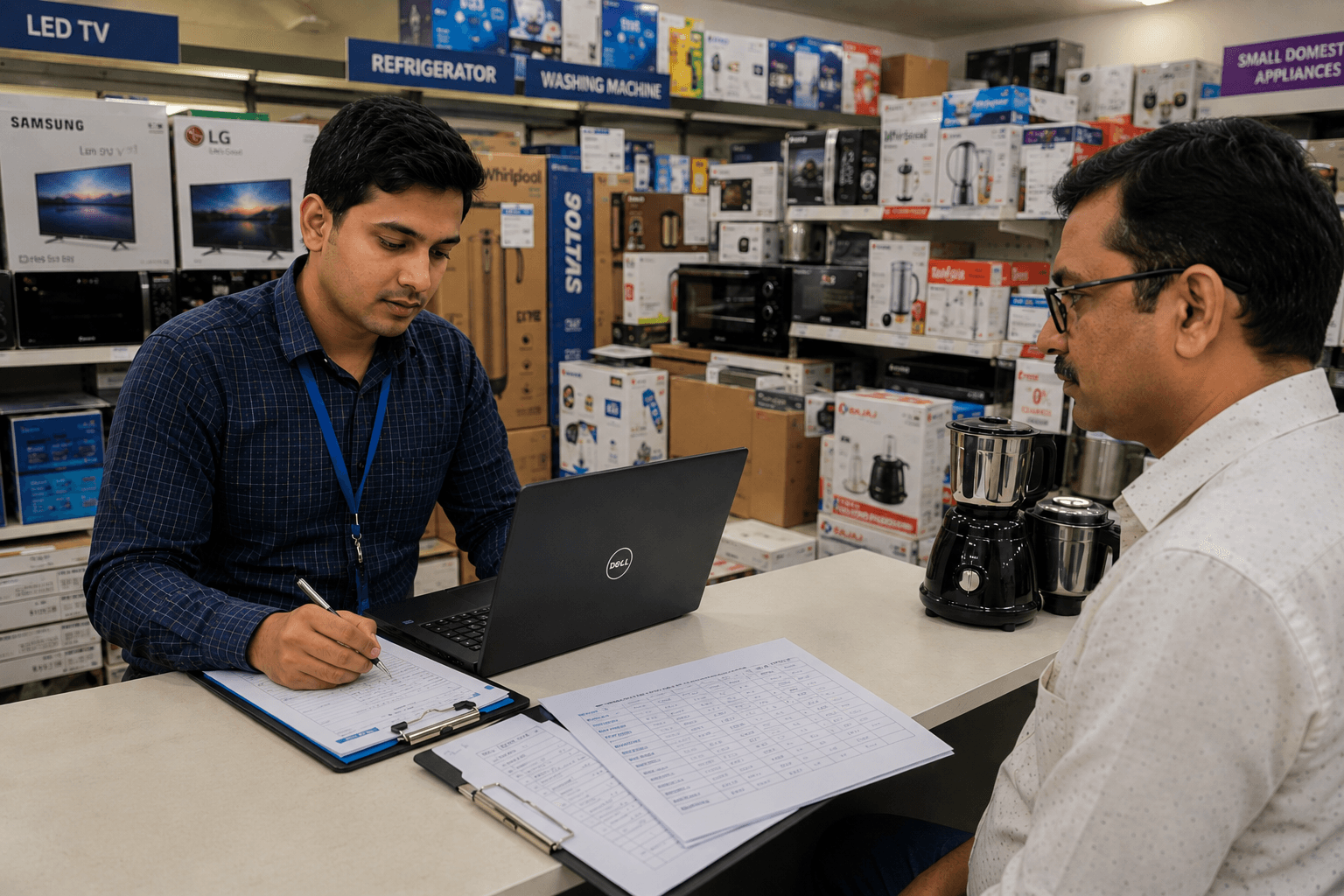
The audit process began with the auditor introducing themselves to the shop owner or manager and explaining the purpose of the visit. The auditor briefed the retailer about the role of retail audit, the value of their contribution, and the market research ethics followed by Market Xcel, including confidentiality and aggregate-level reporting.
Since accurate sales data depends on trust, the team focused on relationship building with retailers. In many cases, it took 2–3 months for shop owners or managers to become comfortable sharing sales data from bill books, computers, sales registers, or other authentic sources. If an outlet continued to provide only verbal data, it was replaced with another outlet matching the same criteria.
The study was executed through a large field network of 130 auditors, 24 Senior Operation Executives, and 8 State Managers. The audit covered more than 800 towns across India.
The towns were divided into:
Headquarters: Towns where the auditor was stationed
Ex-town: Nearby towns where the auditor could travel in the morning, complete audits, and return by evening
Outstation: Distant towns where the auditor had to stay overnight depending on the number of audits
Each auditor was assigned a headquarters location along with ex-town and outstation towns. Each auditor typically handled around 70–80 shops during the audit cycle.
The client’s software was used for data entry. Stores were allotted to auditors before the start of every audit round and pushed to the backend of the software. Each auditor could only view the stores assigned to them after logging in with unique credentials. The auditor opened the outlet code, entered the sales data, clarified invoice-related queries such as model name or price, and synced the data to the server.
Every day, uploaded data was received from the client for checking and QC. The centralized desk cleaning team reviewed the data, cleaned it, and sent queries back to the field wherever clarification was required. A centralized QC team also conducted backchecks by visiting dealers. This team covered all states and checked around 70–80% of dealers over a one-year period.
Audit plans were shared before fieldwork started and were also shared with the client. The client dashboard was used to monitor completed audits, track pending audits, and share regular progress updates with teams. Interim data was shared with the client on a daily basis.
Research Outcome
The retail audit created a recurring, store-level view of product sales, brand movement, model performance, retailer compliance, and market share across key consumer product categories.
Key outcomes included:
Monthly retail audit coverage of 11,000 stores
Stronger visibility into brand market share
Product-level sales tracking across multiple retail categories
Better understanding of store performance and compliance
Improved tracking of model-wise sales and pricing through retail sales analysis
Outlet-level classification by channel and shop size
Daily interim data sharing with the client
Centralized data cleaning and QC for improved accuracy
Dealer backchecks to strengthen data reliability
Continuous monitoring of audit completion through dashboard tracking
Challenges and Actions Taken
Incorrect Model Names and Prices
Incorrect models were sometimes reported because retailers did not write complete or proper model names in invoices. This led to errors in model and price reporting.
Action Taken:
Market Xcel prepared a brand-wise and product-category-wise list of models that were currently active in the market and had been regularly reported in the last six months. During data cleaning, reported models were matched against this list. If a model was unclear or new, the query was sent back to the field team for clarification. Genuine new models were added to the list for future use, while incorrect entries were corrected based on field feedback.
Sudden Increase or Decrease in Sales
The team observed sudden hikes or drops in monthly sales for the same retailer. These variations were often caused by seasonal changes, shops being closed for several days, construction near the outlet, or reduced customer movement.
Action Taken:
Market Xcel started tracking the last three months of sales for each outlet. If any spike or drop was observed, it was immediately sent back to the field team for clarification. Valid reasons for sales variation were shared proactively with the client along with the data, reducing the number of follow-up queries.
Non-Audited Stores
In the early phase, the number of non-audited stores was high, which affected the health of the report and was flagged by the client.
Action Taken:
Market Xcel started monitoring non-audited cases at the auditor level. It was observed that some auditors marked stores as non-audited when shop owners asked them to come later or gave repeated appointments. The process was strengthened by making it mandatory to visit any outlet 3–4 times before marking it as non-audited for base towns, and 2–3 times for outstation towns.
Lower Number of Entries from Large Retailers
The client raised concerns about fewer sales entries being reported from large and extra-large retailers.
Action Taken:
Market Xcel began tracking the number of entries reported by retailers, especially large and extra-large outlets, over a period of time. The team ensured that such dealers had a sufficient number of entries or that valid reasons were documented when the entry count was low, such as the shop being closed for a week.
QC Issues
Despite regular field visits and checks by Senior Operation Executives and Managers, data errors and product category understanding issues continued to appear.
Action Taken:
A centralized QC team was created to conduct independent backchecks in addition to the checks done by field managers and SOEs. This team reported directly to the Project Head in Delhi. Every month, selected towns were picked for backchecks. Feedback was shared immediately with auditors after visits and, communicated to SOEs and managers. The feedback was monitored for the next 2–3 months to track improvement at retailer and auditor level.
Retailers Not Issuing Sales Invoices
Some retailers did not issue sales invoices, especially for small products such as kitchen appliances or when customers did not request bills. This made it difficult to collect authentic sales data.
Action Taken:
Market Xcel designed a Sales Register Book for such retailers. The book included all required data collection points and was placed at the shops. Retailers were encouraged to record each sale in the register. Auditors made regular visits to these dealers and motivated them to maintain entries properly.
Monotony in Sales Data
It was observed that sales data for some retailers became repetitive in terms of brand and model sales, which was not practical in a real market scenario.
Action Taken:
Market Xcel started shifting auditor allocations to break monotony and check whether the pattern was actually happening at the retailer level or whether it was based on the auditor’s assumptions about the retailer’s usual sales.
Business Impact
The retail audit helped the client build a consistent and reliable view of brand market share, product performance, store compliance, and retailer-level sales movement across India. Through monthly audit cycles, outlet classification, software-enabled data entry, centralized cleaning, and dealer backchecks, Market Xcel supported stronger retail measurement across multiple categories.
The study enabled brands to monitor product movement, identify sales trends, detect unusual spikes or drops, validate model and pricing accuracy, and understand retail performance across store types and town classes. It also strengthened long-term panel quality by replacing weak data sources, improving retailer cooperation, and introducing structured processes such as Sales Register Books and centralized QC checks.
Contact us to conduct retail audit study, brand market share tracking, product performance studies, store compliance checks, or retail measurement research across India.
KEEP READING


