Top Marketing Trends for 2026: The Year Marketing Stops Playing Safe
Feb 2026
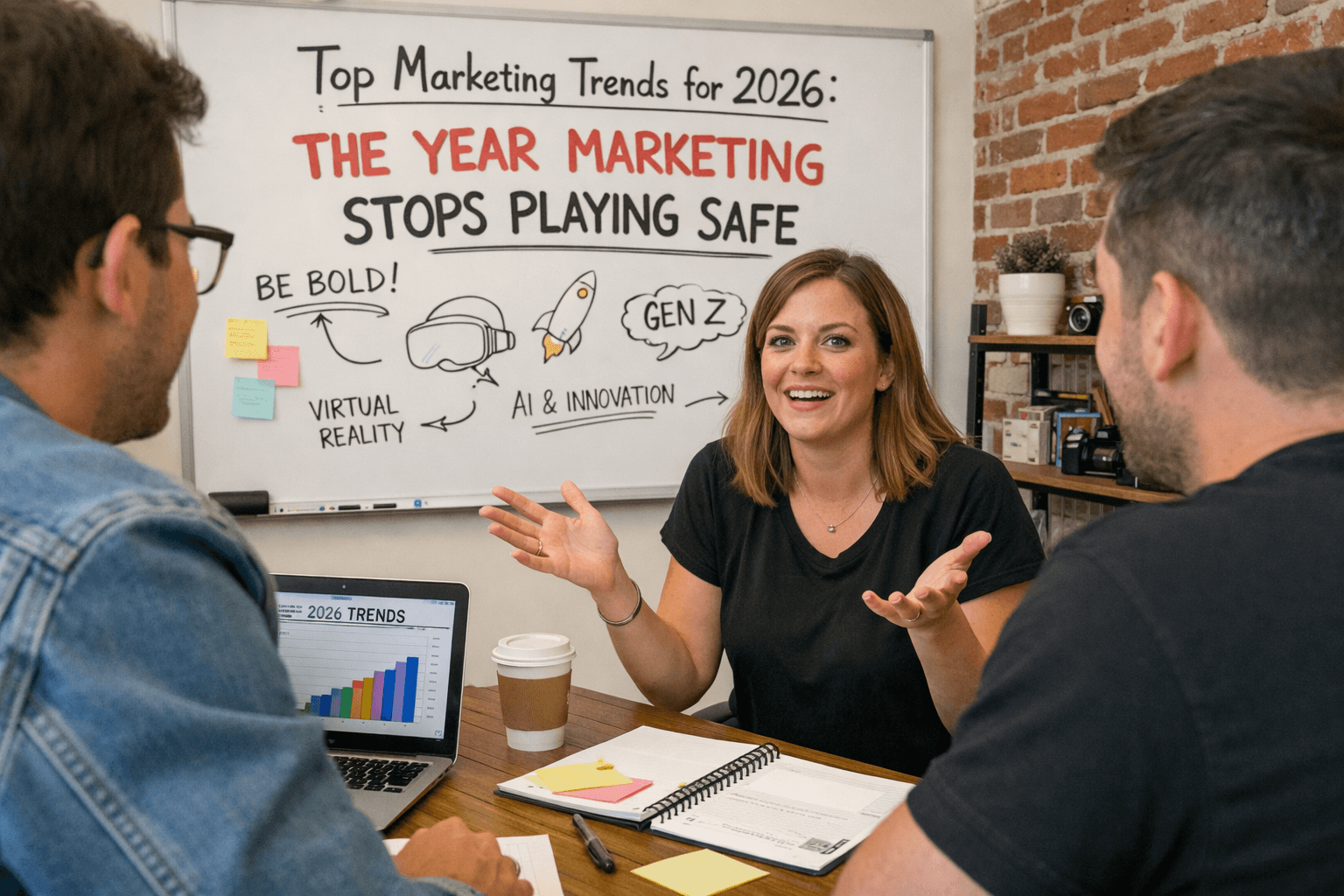
Marketing in 2026 didn’t become harder. It became easier, reflecting the Top Marketing Trends shaping how brands operate today.
AI can generate campaigns, write copy, design visuals, and optimize ads in minutes. Execution that once required teams and timelines now happens instantly. But as marketing became easier to produce, it also became easier to ignore. Because when everyone can create good marketing, good marketing stops standing out, a reality that defines the top marketing trends shaping 2026 and the broader digital marketing evolution.
The result is a new challenge: sameness. The internet is filled with content that is technically correct but emotionally forgettable, optimized for performance, yet invisible in memory, pushing marketers to rethink the future of marketing and rethink brand strategy itself. And that changes everything.
The next phase of marketing isn’t about producing more content or adopting more tools. It’s about producing meaning. The brands winning today are not the ones chasing every new platform or trend; they are the ones redefining how marketing feels, how it builds trust, and how it creates long-term attention, aligning with the future of digital marketing strategy and the Top Marketing Trends emerging globally.
Marketing is shifting from performance optimization to experience creation.
What follows isn’t a list of shiny new tactics or short-lived trends. These shifts are already visible across new-age brands, creator-led businesses, and companies rebuilding how they connect with audiences. Some are driven by technology, others by culture, but together, they point toward a fundamental change in how marketing works and highlight key marketing trends 2026 shaping the industry.
AI Didn’t Replace Marketers - It Made Strategy the Real Skill
AI didn’t eliminate marketing jobs. It eliminated average execution, accelerating the rise of AI in marketing and redefining the top marketing trends marketers must understand.
In 2026, AI tools can generate copy, visuals, landing pages, and campaign variations at scale. The result is a flood of “good enough” marketing. When execution becomes commoditized, the real advantage shifts to strategic thinking, positioning, timing, audience understanding, and clarity of message.
AI can generate options, but it cannot decide what matters. It cannot define brand identity or make trade-offs between short-term growth and long-term equity. Those decisions still require human judgment, reinforcing conversations around how AI is changing brand strategy and the importance of balancing automation with authenticity in marketing.
This is why marketing is moving closer to product and brand strategy. Customer insight is no longer just a marketing input; it shapes what gets built and how it evolves, becoming central to modern growth strategy and marketing innovation.
A strong example of strategy-first thinking in India’s new-age ecosystem is sneaker brand Comet. Instead of relying on heavy advertising or celebrity endorsements, the brand focused on building a culturally relevant identity rooted in storytelling and aspiration. Its growth reflects how strategic positioning can create differentiation even in highly competitive categories and demonstrates the power of brand storytelling within emerging top marketing trends.
The lesson is simple: tools no longer create advantage. Thinking does. In 2026, AI amplifies strategy; it doesn’t replace it, reinforcing why AI in marketing remains an enabler rather than a substitute for human judgment.
Human-First Content Wins in an AI-Saturated World
The more AI-generated content exists, the more audiences crave human signals, accelerating the shift toward human-first marketing in an AI world, one of the defining top marketing trends today.
Consumers are becoming increasingly sensitive to content that feels automated or overly polished. Perfect messaging often performs worse than content that feels real, imperfect, and emotionally grounded. In a world of infinite content, relatability becomes a competitive advantage and strengthens long-term audience engagement and customer loyalty.
This is why founder-led storytelling, creator-driven brands, and community narratives are rising rapidly, supported by the expansion of the creator economy and growing interest in founder-led brand storytelling examples. People trust identifiable voices more than anonymous brand communication. They want perspective, not just promotion.
Beauty and wellness brands in India have embraced this shift early. indē wild, for instance, grew by blending founder storytelling, cultural identity, and community conversations rather than relying solely on product-led advertising. The brand’s communication feels personal and culturally rooted, making audiences feel involved rather than targeted and strengthening community marketing outcomes.
Similarly, NishHair built strong consumer trust through the founder, Parul Gulati’s visibility and educational content around real customer problems. The brand’s growth demonstrates how audiences are increasingly drawn to lived experiences and transparency over polished brand messaging, reinforcing the importance of building trust in modern marketing.
Human-first marketing doesn’t mean rejecting AI. It means using AI to remove friction while preserving the human emotional core, aligning with the need for balancing automation with authenticity in marketing.
In 2026, audiences don’t reward brands that sound intelligent. They reward brands that feel genuine, content that feels authentic, relatable, and, low-key, human in a way automation simply cannot replicate, a defining signal across top marketing trends and the evolving future of marketing.
Search Is Changing: From SEO to AEO (Answer Engine Optimization)
Search behavior is undergoing one of its biggest transformations since the early days of Google, driving new answer engine optimization strategies in 2026 and reshaping the top marketing trends conversation.
AI-powered search experiences are training users to expect direct answers rather than multiple links. This shift is pushing marketers toward Answer Engine Optimization (AEO), creating content that AI systems can trust, summarize, and recommend.
Ironically, this makes depth and expertise more valuable again. Generic content written for keywords is losing effectiveness, while experience-driven, educational content is gaining visibility and influencing the ongoing digital marketing evolution.
Nykaa offers a strong example of this evolution. Its growth has been powered not just by ecommerce but by content, tutorials, reviews, expert advice, and influencer-led education that helps consumers make informed decisions before purchasing. By becoming a trusted source of information, Nykaa positioned itself as a discovery platform rather than just a retailer, strengthening audience engagement and long-term trust.
The focus is shifting from traffic to usefulness. Brands that consistently solve real problems earn both human trust and algorithmic visibility, reflecting emerging privacy-first marketing strategies and value-driven content approaches.
SEO in 2026 is no longer about ranking pages. It’s about becoming the answer people and AI trust first, a central theme within the top marketing trends shaping modern search behavior.
Creativity Becomes the New Performance Marketing
For years, performance marketing was defined by targeting, bidding, and optimization. In 2026, creativity has become the biggest performance lever, giving rise to creativity driven performance campaigns across industries and redefining performance marketing itself within the top marketing trends race.
As privacy changes reduce targeting precision and algorithms become similar across platforms, creative quality determines whether people stop scrolling. Attention is no longer bought; it is earned.
Few Indian brands demonstrate this better than CRED. Its campaigns consistently prioritize storytelling, humor, and unexpected execution over feature-heavy messaging. By turning advertising into entertainment, the brand earns voluntary attention rather than forcing it, illustrating how creative campaigns now directly influence outcomes.
This reflects a larger shift in marketing economics. AI has reduced production barriers, making experimentation faster and cheaper. The advantage no longer lies in budget but in imagination. Brands that can entertain, surprise, or emotionally engage audiences outperform those relying purely on optimization, signaling continued marketing innovation.
In 2026, performance marketing is no longer separate from creative thinking.
Creativity is performance.
Distribution Is the New Moat: Community and Network Effects
Attention has never been harder to sustain. As acquisition costs rise and organic reach becomes unpredictable, brands are realizing that campaigns alone cannot drive long-term growth. Sustainable marketing increasingly comes from distribution systems, communities, creator ecosystems, and customer-driven growth loops, reflecting distribution-led growth models in marketing and community-led brand growth strategies, both central to current top marketing trends.
boAt’s rise in India’s consumer electronics market illustrates this clearly. Instead of relying primarily on traditional advertising, the brand built strong connections with youth culture through influencers, creators, and lifestyle positioning. Customers didn’t just buy products; they became part of a cultural identity that amplified the brand organically, strengthening community marketing dynamics.
This approach reduces dependence on paid media because customers themselves become distribution channels, highlighting the shift toward marketing strategies beyond paid advertising.
In a privacy-first world, first-party relationships and communities are more valuable than rented attention. The brands dominating 2026 don’t just market to audiences; they build environments where audiences market for them.
Distribution, not just messaging, becomes the competitive advantage, reinforcing one of the most important top marketing trends of the year.
The Anti-Hype Era: Smarter Marketing Over Trend Chasing
One of the most defining characteristics of 2026 marketing is restraint, reflecting a more mature phase in marketing trends 2026 and the broader future of marketing.
After years of chasing every new platform, format, or technology, marketers are becoming more selective. Not every AI tool or viral trend delivers business value. The brands seeing sustainable success are focusing on fundamentals: clear positioning, consistent storytelling, and long-term brand building, strengthening brand strategy foundations.
Streetwear label Gully Labs reflects this shift. Instead of competing through aggressive discounts or rapid trend cycles, the brand focuses on identity, culture, and meaning. Its growth demonstrates how clarity of positioning can outperform constant experimentation, especially in premium or community-driven categories and reinforces building trust in modern marketing.
This represents a broader maturation of marketing. Experimentation still matters, but discipline matters more. Choosing fewer initiatives and executing them well is becoming a competitive advantage.
In a domain full of noise, clarity wins, a recurring pattern across today’s top marketing trends.
Absurd Creativity and Playful Chaos: Why Unexpected Marketing Wins Attention
One of the most interesting creative shifts in 2026 is the rise of intentionally unconventional marketing, content that feels unexpected, playful, and sometimes slightly chaotic, aligning with emerging experiential marketing trends 2026 and new forms of audience engagement.
After years of optimized and predictable communication, audiences are responding to brands that surprise them. Perfect logic doesn’t always stop scrolling anymore. What works instead is curiosity, exaggerated visuals, unexpected humor, and storytelling that feels entertaining before it feels promotional.
This shift is partly cultural. Digital-native audiences have grown up in meme-driven environments where irony and randomness are normal forms of communication. Marketing that feels overly serious can feel disconnected from how people actually engage online, accelerating ongoing digital marketing evolution.
Quick-commerce platforms like Swiggy Instamart have embraced this tone effectively, using playful and internet-native humor to remain culturally relevant. Their content often feels conversational and spontaneous rather than scripted, making it more shareable in social environments and strengthening creative campaigns performance.
The lesson isn’t to be strange for attention. It’s to be interesting enough to interrupt routine, content that makes audiences pause because it’s different, confident, and occasionally has a bit of main-character energy.
The IKEA Effect in Marketing: When Customers Become Co-Creators
One of the most important shifts shaping marketing in 2026 is the shift from audience engagement to audience participation, reflecting the rise of customer participation in brand building and redefining top marketing trends around collaboration.
For years, brands focused on speaking to consumers. Today, the most effective brands are built with them. Creator-led ecosystems, user-generated content, and feedback-driven product development are turning customers from passive audiences into active participants in the brand journey, strengthening both community marketing and long-term customer loyalty.
This shift closely mirrors what behavioral psychology calls the IKEA Effect, the idea that people place higher value on things they help build themselves. In marketing, the implication is powerful: when customers contribute ideas, feedback, or content, they develop a deeper emotional investment in the brand. Participation creates ownership, and ownership creates loyalty.
This is why community-led initiatives are gaining importance across modern marketing strategies. When audiences feel heard and involved, they don’t just consume brand messaging; they help shape it and distribute it organically, reinforcing community-led brand growth strategies.
A strong example of this approach can be seen in skincare brand d’you and its recent dyouniverse initiative. Instead of limiting communication to product launches or campaigns, the brand brought together loyal customers and community members to discuss formulations, share feedback, and participate in conversations around future product directions. By inviting customers into the decision-making process, the brand strengthened trust while simultaneously turning its most engaged users into advocates and reinforcing building trust in modern marketing.
The takeaway for marketers is significant. Community is no longer just about engagement metrics or social interaction. It’s about creating environments where customers feel like contributors rather than targets.
In an era where attention is expensive and trust is fragile, brands that build with their audiences, not just for them, create relationships that competitors cannot easily replicate, a defining insight across the top marketing trends shaping 2026.
Final Thoughts: 2026 Is the Year Marketing Becomes Human Again
Across all these trends, one theme stands out:
Technology is accelerating marketing, but humanity is differentiating it, a central idea shaping the future of digital marketing strategy and the most important top marketing trend ahead.
AI will continue to reshape workflows. Automation will improve efficiency through smarter marketing automation. Creative tools will become more powerful and accessible. But as execution becomes easier, differentiation shifts toward something harder to replicate: trust, perspective, creativity, and participation.
The brands that will stand out in 2026 are not necessarily the ones using the most advanced tools. They are the ones building stronger relationships. Brands that invite audiences into the process, listen actively, and create spaces where customers feel involved rather than targeted will build deeper loyalty than any campaign alone can achieve, strengthening long-term growth strategy outcomes.
Marketing is moving away from interruption and toward collaboration. From messaging to meaning. From audiences to communities.
The future of marketing isn’t louder or faster. It’s smarter, more intentional, and unmistakably human, reflecting the direction of the top marketing trends defining the next era of marketing.
For brands looking to navigate this shift with deeper consumer understanding and insight-led decision making, connecting with Market Xcel can help translate evolving marketing trends into actionable research-driven strategies.